E-commerce Email Conversion Playbook: 7 Proven Systems to Drive 40% More Revenue
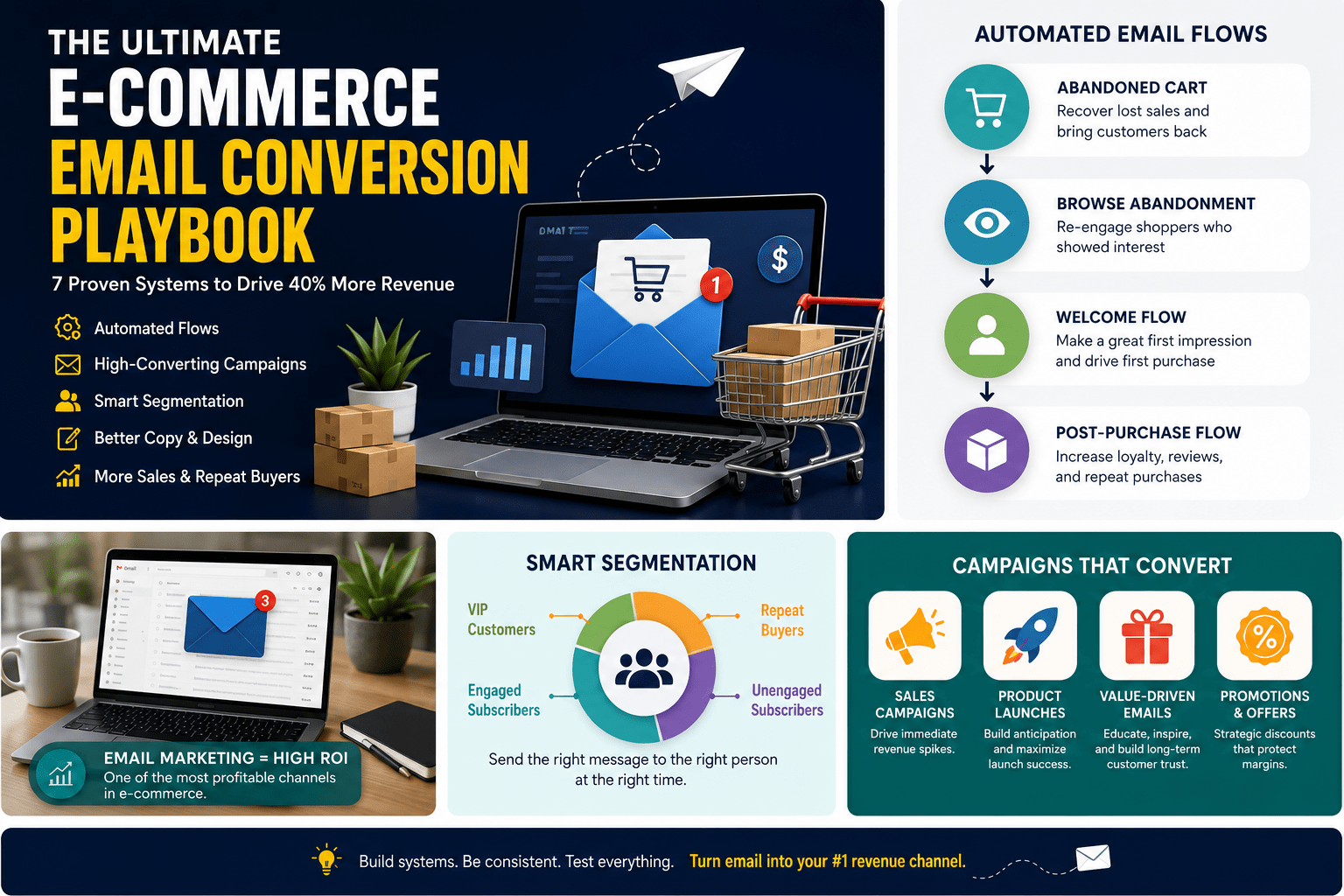
Email marketing remains one of the most profitable channels in online business. While many brands obsess over paid ads and social media, experienced operators know the real long-term revenue comes from owned channels, especially email.
The truth is simple: traffic comes and goes, but email builds a system that consistently generates sales, recovers lost revenue, and increases customer lifetime value.
This E-commerce Email Conversion Playbook is built around the exact systems successful e-commerce brands use to scale to seven, eight, and even nine figures. Instead of random campaigns and inconsistent promotions, top-performing stores create automated email engines that work around the clock.
If implemented correctly, email marketing can generate 20–40% of total store revenue while delivering one of the highest returns on investment in digital marketing.
Why Email Marketing Still Dominates E-commerce
Many marketers wrongly assume email is outdated. In reality, email marketing consistently outperforms most other channels because it gives brands direct access to customers without depending on algorithms.
Unlike social platforms, your email list is an asset you control.
Here’s why email remains essential:
- Higher ROI compared to paid advertising
- Better customer retention
- Increased repeat purchases
- Automated revenue generation
- Personalized customer experiences
- Stronger customer relationships
According to industry reports, email marketing often returns over $36 for every $1 spent. That level of profitability is difficult to match anywhere else.
Top brands treat email like a revenue system, not an afterthought.
Continue reading to download a copy of 5 proven email swipes for eCommerce store owners.
Understanding the E-commerce Email Revenue System
The biggest difference between average stores and elite stores is structure.
Successful brands build email systems in layers:
- Foundational automated flows
- Scheduled campaigns
- Segmentation systems
- Continuous optimization
This creates predictable growth over time.
Why Most Brands Fail With Email
Most stores send random promotional emails without strategy. They lack:
- Automated flows
- Segmentation
- Consistent testing
- Strong copywriting
- Conversion-focused design
As a result, they leave massive revenue untapped.
How Top Brands Approach Email Marketing
Winning brands focus on:
- Customer behavior
- Personalization
- Timing
- Data-driven optimization
- Long-term customer value
Instead of blasting everyone with the same email, they build intelligent systems tailored to customer intent.
Core Email Flows Every E-commerce Brand Needs
Automated flows generate the majority of early email revenue. These behavior-triggered emails reach customers at high-intent moments.
Abandoned Cart Flow
The abandoned cart flow is the highest ROI email automation in e-commerce.
These users already showed buying intent, they simply didn’t finish checkout.
Best Timing Strategy
An effective sequence looks like this:
| Timing | Purpose | |
|---|---|---|
| Email 1 | 1–2 hours | Reminder |
| Email 2 | 12–24 hours | Build trust |
| Email 3 | 48 hours | Incentive + urgency |
High-Converting Cart Recovery Emails
First Email: Reminder
- Show the product
- Reinforce benefits
- Include strong CTA
- Avoid discount coupons
Second Email: Trust Builder
- Add customer reviews
- Handle objections
- Include guarantees
- Highlight social proof
Third Email: Final Push
- Offer discount or free shipping
- Create urgency
- Use scarcity tactics
Dynamic product blocks significantly improve conversion rates because customers immediately recognize the items they left behind.
Browse Abandonment Flow
Browse abandonment captures users who viewed products but didn’t add them to the cart.
While lower intent than abandoned carts, these users are still highly valuable.
Best practices include:
- Trigger within 4–12 hours
- Focus on product benefits
- Include social proof
- Showcase customer reviews
This flow helps pull hesitant shoppers back into the buying journey.
Welcome Flow
Your welcome sequence forms first impressions.
Many brands waste this opportunity by talking endlessly about themselves instead of driving conversion.
A better structure includes:
| Goal | |
|---|---|
| Email 1 | Offer + introduction |
| Email 2 | Brand story |
| Email 3 | Best sellers |
| Email 4 | Education |
| Email 5 | Objection handling |
Top-performing and high-converting welcome email flows educate while guiding subscribers toward their first purchase.
Post-Purchase Flow
Post-purchase emails increase customer lifetime value while reducing refunds and returns.
This is one of the most overlooked areas in e-commerce email marketing.
Essential Post-Purchase Emails
- Order confirmation
- Product education
- Review requests
- Upsells and cross-sells
- Repeat purchase reminders
Great post-purchase sequences build trust and encourage repeat business.
Campaign Strategies That Create Revenue Spikes
Once flows are active, campaigns become your growth accelerator.
Unlike automated flows, campaigns are scheduled broadcasts designed to create immediate revenue spikes.
Sales Campaigns
Sales campaigns work best when structured strategically.
Pre-Launch Phase
- Build anticipation
- Segment audiences
- Tease products or discounts
Launch Phase
- Send launch email
- Follow with reminders
- Finish with “last chance” urgency
Well-executed campaigns can generate massive revenue within days.
Product Launch Campaigns
Product launches require storytelling and anticipation.
Winning launch emails:
- Explain product benefits
- Show customer outcomes
- Use early access incentives
- Include strong visuals
Creating exclusivity often improves click-through and conversion rates.
Non-Discount Campaigns
Relying solely on discounts destroys profit margins.
Strong operators balance promotions with value-driven emails such as:
- Product education
- User-generated content
- Tutorials
- Customer stories
- Problem-solving content
These campaigns strengthen the brand while maintaining profitability.
Writing Email Copy That Converts
Copywriting is where conversion happens.
Even perfectly timed emails fail if the message is weak.
Top-performing email copy feels conversational, direct, and outcome-focused.
Psychology Behind Great Email Copy
Effective email copy:
- Focuses on benefits
- Solves problems
- Creates emotional connection
- Reduces friction
- Builds urgency naturally
Short, clear writing almost always outperforms overly clever messaging.
Subject Line Optimization
Subject lines determine whether emails get opened.
Core Subject Line Techniques
- Curiosity
- Benefits
- Urgency
- Exclusivity
- Personal tone
- Pattern interruption
Best Practices
- Keep under 50 characters
- Avoid spam words
- A/B test regularly
- Use natural language
Subject line testing alone can dramatically improve campaign performance.
CTA Best Practices
Every email should have:
- One primary goal
- Multiple CTA placements
- Clear action language
- High visibility
Examples:
- Shop Now
- Complete Your Order
- Claim Your Offer
- View Collection
Avoid vague calls-to-action like “Learn More” when possible.
Designing Emails for Maximum Conversion
Good design supports conversion instead of distracting from it.
Mobile-First Email Design
Most e-commerce emails are opened on mobile devices.
That means your emails should:
- Load quickly
- Use large buttons
- Have readable fonts
- Include short paragraphs
- Display products clearly
Visual Hierarchy
Strong hierarchy guides readers naturally through the email.
Use:
- Headlines
- Subheadings
- Product images
- CTA buttons
- White space
Clear structure improves readability and click-through rates.
Product Placement Strategies
Always make products visible quickly.
Best practices:
- Use lifestyle imagery
- Highlight benefits near products
- Showcase reviews beside items
- Keep CTAs close to products
Great design reduces decision fatigue and simplifies purchasing.
Advanced Segmentation Strategies
Segmentation separates high-performing email programs from average ones.
Instead of sending identical emails to everyone, segmentation personalizes communication.
VIP Customers
VIP buyers deserve:
- Early access
- Exclusive offers
- Higher frequency
- Personalized rewards
These customers generate disproportionate revenue.
Repeat Buyers
Repeat buyers already trust your brand.
Focus on:
- Upsells
- Complementary products
- Loyalty rewards
- Replenishment reminders
Engaged vs Unengaged Subscribers
Sending too frequently to inactive subscribers hurts deliverability.
Instead:
- Increase sends to engaged users
- Reduce frequency for inactive users
- Run re-engagement campaigns
This protects inbox placement and improves overall performance.
Building a Scalable Email Marketing Machine
At scale, email becomes a repeatable system rather than isolated campaigns.
Weekly Campaign Systems
Top brands often send:
- 2–4 campaigns weekly at intermediate stages
- 5–7 campaigns weekly at advanced stages
Consistency beats occasional creativity.
Performance Tracking Metrics
Key email metrics include:
| Metric | Why It Matters |
|---|---|
| Revenue per recipient | Profitability |
| Conversion rate | Sales efficiency |
| Click-through rate | Engagement |
| Unsubscribe rate | Audience fatigue |
Tracking the right metrics prevents poor decision-making.
Continuous Testing Framework
Always test:
- Subject lines
- Offers
- Send times
- Layouts
- CTAs
- Product positioning
Small improvements compound dramatically over time.
Timing and Frequency Optimization
Timing matters, but consistency matters even more.
Best Email Timing for E-commerce
Recommended timing:
- Abandoned cart: 1h → 24h → 48h
- Browse abandonment: 4–12h
- Welcome flow: immediate
- Post-purchase: product-dependent
How Often Brands Should Send Emails
| Brand Stage | Frequency |
|---|---|
| Beginner | 1–2 emails/week |
| Intermediate | 2–4 emails/week |
| Advanced | 5–7 emails/week |
Higher frequency works when content quality remains strong.
Beginner 3-Week Email Marketing Plan
First Week
- Build abandoned cart flow
- Create welcome sequence
Second Week
- Launch post-purchase flow
- Begin weekly campaigns
Third Week+
- Implement segmentation
- Start testing
This phased approach prevents overwhelm while building momentum.
High-Converting Subject Line Examples
Here are some proven examples:
- You forgot something
- Quick question
- Still thinking it over?
- Don’t miss this
- Last chance
- Ending tonight
- Your order is waiting
- We saved this for you
- Just dropped
- This won’t last
- Exclusive access
- Final call
- Open this
- Real results
- This one converts
These subject lines leverage curiosity, urgency, and personalization.
Frequently Asked Questions
What is the most profitable e-commerce email flow?
The abandoned cart flow is typically the highest ROI automation because it targets users with strong buying intent.
How much revenue should email marketing generate?
Well-optimized email systems often generate 20–40% of total e-commerce revenue.
How many emails should an e-commerce brand send weekly?
Most brands succeed with 2–4 emails weekly, while advanced operators may send daily campaigns.
What makes a good subject line?
Good subject lines are short, curiosity-driven, benefit-focused, and natural sounding.
Should brands always offer discounts in emails?
No. Overusing discounts damages margins and weakens brand positioning. Value-based campaigns are equally important.
Why is segmentation important in email marketing?
Segmentation improves relevance, engagement, deliverability, and conversion rates by tailoring emails to customer behavior.
Conclusion
The biggest misconception in e-commerce is thinking email marketing is simply about sending promotions.
In reality, successful email marketing is about building a predictable revenue system.
Brands that implement strong automated flows, strategic campaigns, intelligent segmentation, and ongoing optimization consistently outperform competitors.
The opportunity is enormous.
While many businesses still treat email as an afterthought, elite operators understand that email marketing compounds over time — increasing customer lifetime value, strengthening retention, and driving scalable revenue growth.
If you build the systems outlined in this E-commerce Email Conversion Playbook, email can become one of the most profitable assets in your business.
For additional email marketing best practices, visit HubSpot Email Marketing Guide
Download free PDF of a high converting eCommerce email Welcome Series.